A Kitchen Pure Water Purifier is a household system designed to improve drinking and cooking water at its point of use. It may use activated carbon, reverse osmosis, ultrafiltration, ultraviolet treatment, or several methods together. The right choice depends on local water quality, household needs, and maintenance habits.
Dr. Joseph Cotruvo, a recognized drinking-water treatment expert, has stated, “Safe drinking water depends on effective treatment and careful maintenance.” This principle matters in the kitchen. A purifier may reduce chlorine taste, unpleasant odors, sediment, and certain contaminants. However, no single device removes everything. Product claims should be checked against independent testing, certification, and the exact filter model.
Picture a glass filled beside the sink. It looks clear, but appearance cannot confirm safety. A used cartridge may also become a weak point when replacement is delayed. Small details matter, including water pressure, installation space, filter capacity, and the purifier’s wastewater output.
Experience teaches a less comfortable lesson. Many people buy advanced systems, then neglect routine servicing. That defeats part of the investment. A reliable Kitchen Pure Water Purifier should fit real household behavior, not only impressive specifications. Users should read performance data, follow replacement schedules, and test water when concerns arise. Cleaner water is not created by marketing alone. It requires suitable technology, honest information, and consistent care. This guide examines how these systems work, what they can realistically remove, and which selection mistakes deserve more attention.
What Is a Kitchen Pure Water Purifier?
Definition and Purpose of a Kitchen Pure Water Purifier
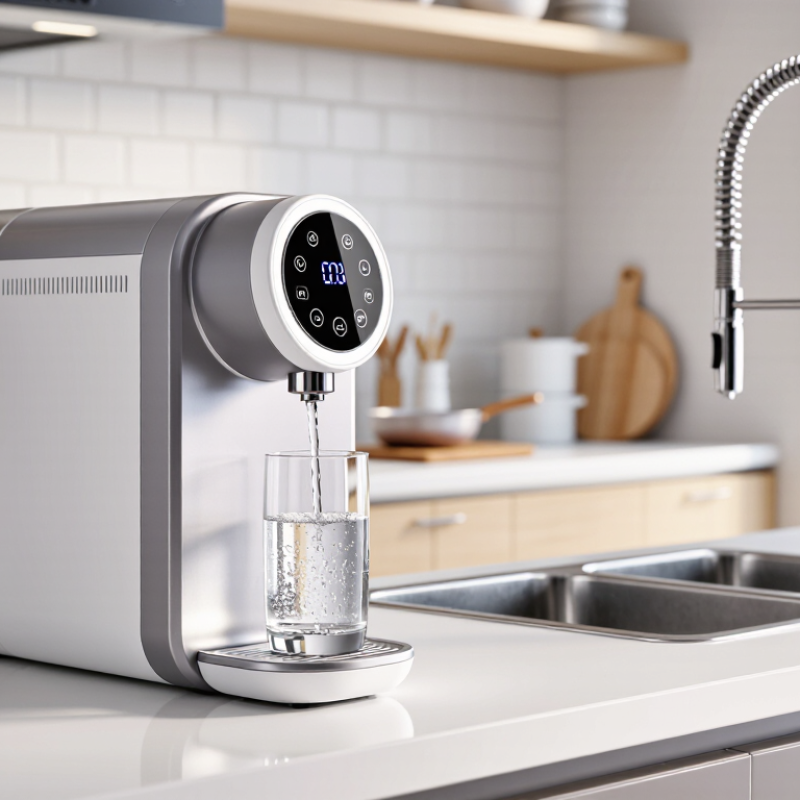
A kitchen pure water purifier is a point-of-use device installed near a sink or drinking-water tap. It treats incoming water through filters or membrane technology. Common stages include sediment filtration, activated carbon, and, in some systems, reverse osmosis. Each stage targets different impurities, such as visible particles, chlorine taste, dissolved minerals, or certain microorganisms.
Its main purpose is to improve water quality for drinking, cooking, and washing fresh food. A purifier can make tap water clearer and more pleasant to drink. It may also reduce unwanted odors in ice, soup, and steamed vegetables. The result depends on the source water and the system’s design. “Pure” does not mean every contaminant disappears.
Practical use requires regular attention. A clogged filter may reduce flow and allow poor performance. Replacement intervals should follow the manufacturer’s instructions and actual household usage. Families with older plumbing should also check their local water-quality report. Independent certification can provide stronger evidence than advertising claims. I have found that users often focus on the filter itself but overlook sanitation around the faucet. That is a weak point. A clean-looking unit can still need careful maintenance, testing, and timely replacement.
| Data Dimension | Definition or Technical Description | Typical Information | Kitchen Purpose |
|---|---|---|---|
| Basic Definition | A kitchen pure water purifier is a point-of-use treatment device installed at or near a kitchen water outlet. | It treats a limited quantity of water for drinking, cooking, beverage preparation, and other food-related uses. | Provides treated water without requiring the entire building plumbing system to be filtered. |
| Main Treatment Objective | The objective is to reduce selected physical, chemical, or microbiological contaminants according to the treatment technology used. | No single purifier removes every contaminant. Performance depends on the source water, filter design, flow rate, and maintenance. | Improves water quality for intended kitchen applications while matching treatment to local water conditions. |
| Common Installation Types | Kitchen purifiers may be installed under the sink, on the countertop, or at a dedicated drinking-water faucet. | Under-sink systems save counter space; countertop systems are generally easier to install and relocate. | Allows households to choose between higher capacity, easier installation, and lower space requirements. |
| Sediment Filtration | A mechanical filter captures suspended particles such as sand, rust, silt, and pipe debris. | Common nominal ratings are approximately 1–5 micrometres, although actual performance varies by filter construction and test method. | Protects later treatment stages and improves water clarity. |
| Activated Carbon Filtration | Activated carbon adsorbs many organic compounds and can reduce chlorine, taste, and odor when properly designed and maintained. | Carbon performance depends on carbon type, contact time, water chemistry, and cartridge capacity. | Makes drinking water more acceptable in taste and smell and can protect reverse-osmosis membranes from chlorine damage. |
| Ultrafiltration (UF) | UF uses a membrane with very small pores to reduce suspended solids, bacteria, and some larger microorganisms. | UF membrane pore sizes are commonly around 0.01 micrometres. UF generally does not remove dissolved salts or many small dissolved chemicals. | Provides particle and microbiological reduction while usually retaining beneficial minerals and producing little or no reject water. |
| Reverse Osmosis (RO) | RO forces water through a semipermeable membrane to reduce many dissolved salts, metals, nitrate, fluoride, and other dissolved substances. | The effective separation scale is commonly described as approximately 0.0001 micrometres. Actual reduction rates differ by contaminant and operating conditions. | Useful where dissolved solids or specific chemical contaminants are a concern. |
| Ultraviolet (UV) Treatment | UV light can inactivate bacteria, viruses, and other microorganisms when the water is clear enough and the dose is adequate. | UV does not remove sediment, dissolved chemicals, salts, or unpleasant tastes and odors. | Adds microbiological treatment to compatible filtration systems. |
| Distillation | Distillation boils water and condenses the steam, leaving many non-volatile contaminants behind. | It can reduce many dissolved solids and microorganisms but requires heating energy and may not remove all volatile compounds without additional treatment. | Produces highly treated water for selected drinking and cooking uses. |
| TDS Reduction | Total dissolved solids, or TDS, represent the combined concentration of dissolved substances in water. | RO and distillation usually reduce TDS substantially; carbon, sediment filters, and UV generally have little effect on TDS. | Helps address mineral taste or high dissolved-solids conditions, but TDS alone does not identify whether water is safe. |
| Filter Replacement | Filter cartridges and membranes have finite capacities and must be replaced according to usage, water quality, and manufacturer instructions. | Replacement intervals may range from several months to multiple years depending on the component and operating conditions. | Maintains treatment performance and reduces the risk of microbial growth in exhausted filters. |
| Water Production Rate | The production rate is the volume of treated water delivered within a specified period. | Flow depends on pressure, temperature, membrane condition, filter loading, and purifier design. RO systems are typically slower than simple carbon filters. | Determines whether the purifier can meet drinking, cooking, and beverage-preparation demand. |
| Reject Water | Some membrane systems, especially RO systems, discharge a concentrated stream containing rejected contaminants. | The amount varies substantially by system design, water pressure, membrane condition, and recovery setting. | Affects water efficiency and may require suitable drainage or reuse planning where appropriate. |
| Storage Tank | A storage tank holds treated water so it can be delivered quickly when the faucet is opened. | Tank capacity is selected according to household demand and available installation space. | Improves availability when the purification process has a relatively slow flow rate. |
| Water Quality Testing | Testing identifies contaminants in the incoming water and helps determine which treatment stages are appropriate. | Useful tests may include microbiological indicators, lead, nitrate, fluoride, arsenic, hardness, chlorine, and TDS, depending on local risks. | Prevents selecting a purifier based only on taste or TDS when a specific contaminant requires targeted treatment. |
| Certification Consideration | Independent certification can verify claims for specific contaminant reductions and material safety. | Certification should be checked for the exact contaminant claim, treatment standard, and replacement component—not merely for the presence of a general label. | Provides a more reliable basis for comparing treatment performance. |
| Overall Purpose | The overall purpose is to provide water treated for the specific needs of a kitchen point of use. | A suitable purifier balances contaminant reduction, flow rate, maintenance, installation requirements, operating cost, and water efficiency. | Supports safer and more pleasant drinking and cooking water when correctly selected, installed, and maintained. |
What Is a Kitchen Pure Water Purifier?
A kitchen pure water purifier usually combines several treatment stages. Water first passes through a sediment filter. This captures sand, rust, and visible particles. A carbon filter then adsorbs chlorine, odors, and some organic compounds. Pressure matters. In reverse osmosis systems, water moves through a semipermeable membrane. Dissolved salts, metals, and other contaminants remain largely on the wastewater side. A final carbon stage can improve taste. Some units add ultraviolet treatment, but UV does not remove dissolved chemicals.
The World Health Organization and UNICEF reported that 2.2 billion people lacked safely managed drinking water in 2022. This figure explains why treatment quality deserves careful attention. However, no purifier removes everything. Performance depends on the source water, pressure, temperature, and filter condition. NSF/ANSI 58 evaluates reverse osmosis systems, while NSF/ANSI 42 commonly covers taste and chlorine reduction claims. Look for certification matched to the contaminant, not vague “pure water” language. The U.S. Environmental Protection Agency notes that conventional point-of-use reverse osmosis systems may discharge about five gallons for every gallon treated. WaterSense-labeled models must perform more efficiently. That waste is easy to overlook. A neglected filter can also reduce flow and invite hygiene problems. Testing the incoming water remains sensible, especially in older homes. Manufacturer instructions help, but real household conditions can still differ.
A kitchen pure water purifier typically combines sediment filtration, activated carbon, and reverse osmosis. Each stage targets different impurities before the water reaches the drinking-water outlet.
The chart compares representative nominal filtration ratings. A smaller pore rating indicates finer physical filtration. Sediment filters commonly remove larger particles, activated carbon helps reduce chlorine, odors, and many organic compounds, while reverse osmosis uses a semipermeable membrane to reduce dissolved salts and many microscopic contaminants. Actual performance varies by filter design, water quality, pressure, and maintenance.
Ultraviolet treatment is not shown because it uses light rather than a pore-size barrier; it is commonly used to inactivate microorganisms when properly designed and maintained.
A kitchen pure water purifier is a point-of-use system designed to improve drinking and cooking water. “Pure” does not mean chemically perfect. Performance depends on the source water, maintenance, and certified claims.
Activated carbon is often the first defense. It can reduce chlorine, unpleasant tastes, and selected organic compounds. Sediment filters capture sand, rust, and visible particles. Reverse osmosis uses pressure through a semipermeable membrane. It can reduce dissolved salts, some metals, and other contaminants, but it also produces wastewater and removes minerals. Ultraviolet treatment targets microorganisms, yet it cannot remove chemicals or cloudy particles. The U.S. NSF/ANSI framework separates functions clearly: Standard 42 covers aesthetic effects, Standard 53 covers selected health-related contaminants, and Standard 58 covers reverse osmosis systems. Check the exact contaminant claim, not just the word “purifier.”
The need is substantial. WHO and UNICEF’s Joint Monitoring Programme reported that 2.2 billion people lacked safely managed drinking water in 2022. Still, one device cannot solve every water problem. The U.S. Environmental Protection Agency’s 2024 PFAS rule shows why precise testing matters, with limits of 4.0 nanograms per liter for PFOA and PFOS. Household users should test source water, replace cartridges on schedule, and inspect storage tanks. Maintenance is easy to postpone. That is the weak point. A neglected filter may reduce performance, even when the exterior still looks clean.
A kitchen pure water purifier is a point-of-use system designed to improve drinking and cooking water. Its core components usually include a sediment filter, carbon filter, membrane, and final polishing filter.
The sediment stage catches sand, rust, and visible particles. Carbon reduces chlorine, odors, and some organic compounds. A reverse osmosis membrane can reduce dissolved salts and certain contaminants, but performance depends on water pressure and maintenance.
An under-sink unit saves counter space and connects to a dedicated drinking-water faucet. It normally needs a cold-water inlet, drain connection, storage tank, and automatic shutoff valve.
A countertop purifier is easier to install and suits rented kitchens. It may need manual refilling, though.
A whole-house system treats more outlets, but it is not always necessary for drinking water and usually requires more plumbing work.
A poorly fitted tube can create a slow leak behind the cabinet. Check every connection after installation.
Replace filters according to water quality, usage, and test results, not only calendar dates. Neglected filters can reduce flow and affect water taste.
I would also leave space for filter changes; cramped cabinets make routine care easy to postpone.
Water testing before and after installation gives a more reliable view of purifier performance.
A kitchen pure water purifier is a compact system that treats drinking water at the point of use. It may combine sediment filters, activated carbon, and reverse osmosis membranes. Each stage handles a different problem, from visible particles to unpleasant tastes and dissolved contaminants. In practical kitchen use, clean water can improve coffee, cooking, and the flavor of fresh vegetables. The improvement is noticeable, but it is not magic. Water quality still depends on the incoming supply and the purifier’s design.
Maintenance decides whether the benefits last. Sediment and carbon filters need replacement according to usage, water quality, and manufacturer guidance. A neglected filter can reduce flow and create hygiene concerns. Reverse osmosis systems also produce wastewater, which may feel wasteful in dry regions. They can remove useful minerals, too. Some households may need remineralization, although this choice should follow water testing and professional advice. A purifier cannot solve every issue, and poor installation may cause leaks or contamination.
Tips: Mark filter changes on a kitchen calendar. Clean the faucet outlet gently and keep the storage tank covered. Check for slow flow, strange odors, or unusual taste. Test treated water periodically if supply quality changes. Do not assume a higher price means better protection. An accredited water professional can interpret test results and confirm whether the system fits your home. Small mistakes happen. Regular attention matters more.