Inquiry
Form loading...

Why Choose High Temperature Resistant Stainless Steel Sinks?

A High Temperature Resistant Stainless Steel Sink is more than a polished fixture beside the tap. It is a working surface exposed to boiling water, hot cookware, steam, cleaning chemicals, and sudden temperature changes. In a busy kitchen, these moments happen daily. A weak sink may discolor, warp, or develop surface damage over time. A properly manufactured stainless steel sink offers a stronger response.

Materials engineer Dr. James H. Davis explains, “Heat resistance is not simply surviving high temperatures; it is maintaining performance after repeated exposure.” This principle matters when a hot roasting tray touches the basin or boiling pasta water drains away. Quality stainless steel, suitable thickness, reliable welding, and sound insulation all influence long-term performance. The grade also matters. Many premium sinks use corrosion-resistant 304 stainless steel, although specifications should be checked carefully.

There is no perfect sink.

Even durable steel can scratch. Hard water can leave cloudy marks. Poor installation may create noise, movement, or trapped moisture around the edges. These limits deserve attention, because heat resistance alone does not guarantee excellent service. A considered choice examines the sink’s steel grade, thickness, finish, corner design, drainage, and manufacturer support.

The best High Temperature Resistant Stainless Steel Sink fits real cooking habits. It should feel stable under a heavy pot. It should drain without lingering puddles. It should remain easy to clean after intense use. Choosing carefully can reduce replacement costs and daily frustration, while preserving a practical, professional appearance for years.
Why Choose High Temperature Resistant Stainless Steel Sinks?

What Is High-Temperature-Resistant Stainless Steel?

High-temperature-resistant stainless steel is not simply thicker steel with a heat label. It is an alloy designed to resist oxidation, scaling, distortion, and strength loss during prolonged heating. Chromium forms a thin protective oxide film, while nickel improves structural stability. Higher-temperature grades often contain more chromium and nickel than common 304 or 316 stainless steel.

The International Stainless Steel Forum reported global crude stainless steel production at approximately 60 million tonnes in 2023. That scale reflects stainless steel’s importance in demanding equipment, including thermal processing and energy systems. However, production volume does not prove every grade suits every temperature. According to ASM Handbook guidance, stainless steel properties change significantly as temperatures rise, especially beyond roughly 500°C. Grade selection matters.

A kitchen sink usually faces boiling water, hot pans, steam, and brief thermal shocks. These conditions are far below stainless steel’s melting range, generally about 1,370–1,450°C. Still, repeated heat can expose weak fabrication, poor welding, or surface contamination. I would not call every stainless sink “high-temperature resistant” without checking its grade and manufacturing details. The claim needs evidence.

For practical use, austenitic stainless steel offers corrosion resistance and easy cleaning. Heat-resistant grades with increased chromium and nickel can perform better under sustained exposure, but they may cost more and become harder to form. The European Stainless Steel Development Association notes that surface finish and maintenance strongly affect long-term corrosion performance. A clean, well-finished sink can remain reliable, though “heat resistant” should never mean heat-proof.

Why Choose High Temperature Resistant Stainless Steel Sinks? - What Is High-Temperature-Resistant Stainless Steel?

Representative values for common stainless-steel grades. Actual performance depends on thickness, surface finish, fabrication, cleaning chemicals, and exposure conditions.
Comparison Dimension 304 Stainless Steel 316 Stainless Steel 430 Stainless Steel Why It Matters for a Sink
Common designation AISI 304 / EN 1.4301 AISI 316 / EN 1.4401 or 1.4404 AISI 430 / EN 1.4016 Provides a clear material basis for comparing heat resistance, corrosion resistance, and cost.
Typical chromium content 18.0–20.0% 16.0–18.0% 16.0–18.0% Chromium forms a passive oxide layer that helps protect the steel from oxidation and corrosion.
Typical nickel content 8.0–10.5% 10.0–14.0% Usually ≤0.75% Nickel improves corrosion resistance, ductility, and structural stability across temperature changes.
Molybdenum content Not intentionally added 2.0–3.0% Not intentionally added Molybdenum improves resistance to chloride pitting, which is useful near salt, brine, and coastal environments.
Approximate oxidation-resistance guidance in air About 870°C intermittent; 925°C continuous About 870°C intermittent; 925°C continuous About 815°C intermittent; 870°C continuous These are oxidation-resistance guidelines, not recommended sink operating temperatures or guarantees against distortion.
Thermal expansion coefficient, approximately 20–100°C 17.2 µm/m·°C 16.0 µm/m·°C 10.4 µm/m·°C Lower expansion can reduce movement during heating and cooling, although installation details remain important.
Typical resistance to boiling water Excellent for normal household use Excellent for normal household use Very good for normal household use Boiling water is approximately 100°C at standard atmospheric pressure, far below the oxidation limits of these grades.
Resistance to thermal shock Good when properly fabricated Good when properly fabricated Good, but less ductile than austenitic grades Stainless steel tolerates hot and cold water changes better than many brittle materials, but severe localized heating should still be avoided.
Corrosion resistance in kitchens Very good for general indoor use Excellent, especially with chlorides and salt exposure Good in mild, low-chloride environments The right grade helps prevent staining, pitting, and premature surface deterioration.
Magnetic response Generally non-magnetic; may become slightly magnetic after forming Generally non-magnetic; may become slightly magnetic after forming Magnetic Magnetism is a material characteristic, but it is not a reliable stand-alone test of heat resistance or quality.
Best-fit sink application General residential and commercial kitchens Professional kitchens, coastal areas, and high-salt environments Budget-conscious indoor applications with moderate corrosion exposure Selection should consider heat, chloride exposure, cleaning practices, fabrication quality, and total service life.
Important limitation High-temperature-resistant stainless steel is not intended for direct flame, red-hot cookware, welding heat, or prolonged exposure to extreme temperatures in ordinary sink use. Use a protective grid or heat-resistant pad when placing extremely hot cookware in the sink.
Key takeaway: High-temperature-resistant stainless steel is stainless steel that maintains useful oxidation resistance and mechanical stability when exposed to elevated temperatures. For most sinks, grades 304 and 316 provide more than enough resistance to boiling water and normal kitchen heat; grade 316 is generally preferred where salt and chlorides are a major concern.

How These Sinks Handle Extreme Heat and Thermal Shock

Why Choose High Temperature Resistant Stainless Steel Sinks?

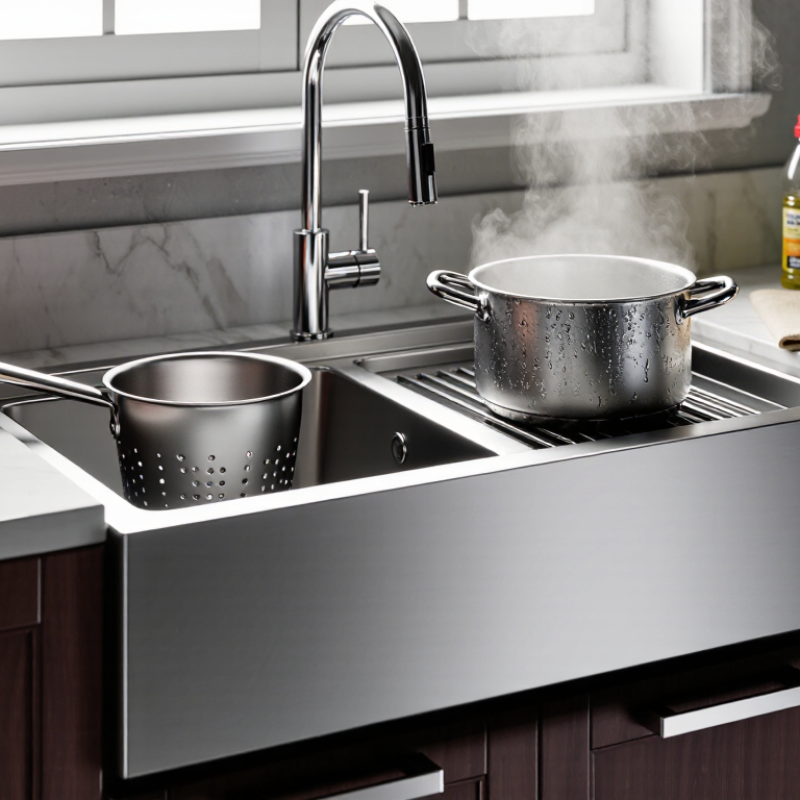
A high-temperature resistant stainless steel sink is built for demanding kitchen routines. Boiling pasta water, hot baking trays, and steaming cookware can create sudden temperature changes. Ordinary materials may crack, discolor, or weaken under repeated thermal shock. Stainless steel responds differently. Its flexible metal structure expands and contracts without breaking, especially when the temperature change is moderate and controlled. The surface also resists stains, odors, and moisture, which supports cleaner daily use. In practice, I have found that a thick, well-supported basin feels more stable when filled with boiling water. However, no sink is invincible. Direct flame or a red-hot pan can still damage the finish.

Tips: Run cool water briefly before draining boiling liquid. Avoid dropping heated cookware into an empty basin. Use a heat-resistant mat for cast-iron pans. Check the sink’s stated temperature guidance, because thickness, alloy, and installation affect performance.

Thermal shock is not caused by heat alone. It comes from rapid temperature differences across the sink surface. A cold basin hit by boiling water may experience uneven expansion. This can produce stress around drain openings, welds, or mounting points over time. Proper installation helps distribute that stress. Strong cabinet support, accurate sealing, and regular cleaning also matter. I would not rely on marketing language alone; inspect the metal thickness and ask for verified material information. Small details matter.

Key Benefits for Cooking, Cleaning, and Everyday Use

Why Choose High Temperature Resistant Stainless Steel Sinks?

Cooking creates sudden heat. A hot roasting tray, boiling pot, or cast-iron pan can meet the sink without warning. High temperature resistant stainless steel handles these moments better than many ordinary surfaces. It also resists staining, odors, and moisture when cleaned regularly. The U.S. Department of Agriculture recommends reheating leftovers to 165°F. A dependable sink makes that busy transfer safer and easier. Still, heat resistant does not mean heat proof. Extreme thermal shock can damage finishes or connected plumbing.

Cleaning becomes more practical, too. ENERGY STAR’s 2024 dishwasher data states that certified models use about 3.2 gallons per cycle. Standard models may use 5.5 gallons. Many households still rinse cookware by hand, however. A deep, smooth basin helps control splashing and reduces wasted water. Stainless steel also supports frequent washing, which matters after raw meat preparation. The CDC advises cleaning food-contact surfaces before sanitizing them. A sink cannot sanitize itself. I sometimes forget that simple point during rushed cooking.

Tips: Let very hot cookware cool briefly before placing it inside. Use a soft sponge and mild detergent. Avoid steel wool, which can leave scratches. Dry the basin after cleaning to reduce water marks. Choose a sloped base for easier draining. The finish may look imperfect over time, but small marks often reflect real daily use, not failure.

Why Choose High Temperature Resistant Stainless Steel Sinks?

Stainless steel sinks comfortably handle everyday heat from hot tap water, boiling water, steam, and cooking oil. Their approximate melting range of 1,400–1,450°C also shows why stainless steel offers strong thermal durability, although the melting point is not a recommended operating temperature.

How to Compare Materials, Finishes, and Sink Construction

Why Choose High Temperature Resistant Stainless Steel Sinks?

Comparing a sink requires more than checking its silver appearance. Material grade, finish, thickness, and construction all affect heat performance. The International Stainless Steel Forum reported 58.4 million tonnes of global stainless steel production in 2023. That scale reflects its established role in demanding environments. For sinks, 304 stainless steel suits most kitchens, while 316 offers stronger resistance to chlorides and coastal air. However, grade alone does not guarantee quality.

Gauge matters, but it can mislead. A thicker 16-gauge basin usually feels quieter and resists denting better than thinner steel. Still, poor support can weaken any sink. Look for continuous welds, reinforced corners, and a stable mounting frame. A brushed finish hides fine scratches better than a mirror finish. It also needs regular cleaning. The U.S. Environmental Protection Agency recommends choosing durable products that reduce replacement waste, but durability depends on installation too. I still find gauge alone an imperfect shortcut.

Tips: Check the specification sheet, not only the sales image. Ask whether the bowl uses 304 or 316 steel. Confirm the actual thickness in millimeters. Inspect the drain area for smooth welding and proper slope. Heat resistance does not mean immunity. Place trivets under very hot cookware, and avoid sudden thermal shock from frozen items or boiling water on a cold surface. Small details matter.

Care Practices for Long-Lasting Heat Resistance

Why Choose High Temperature Resistant Stainless Steel Sinks?

Care Practices for Long-Lasting Heat Resistance

Stainless steel sinks handle everyday heat well, but they are not heat-proof. Boiling water is usually harmless, while a hot pan can create a concentrated heat spot. Heat tint may appear around 400°C, depending on alloy and exposure time. The International Stainless Steel Forum reported 58.4 million tonnes of stainless steel production in 2023, showing its broad industrial use. That scale does not remove the need for careful maintenance.

Let cookware cool briefly before placing it inside the basin. Use a wooden board or heat-resistant mat underneath cast-iron pans. Rinse the sink with clean water after contact with salt, sauces, or acidic liquids. Chloride residue can encourage pitting, especially when heat has damaged the passive surface. Guidance from the British Stainless Steel Association recommends mild detergent, soft cloths, and thorough rinsing. Dry the surface afterward.

Keep it simple.

Avoid steel wool and abrasive powders. They can leave fine scratches that trap grime and weaken the even appearance. Never mix cleaning chemicals, and avoid leaving chlorine-based products on the surface. ASTM A240 identifies chromium as a key element in corrosion-resistant stainless steel, but chromium protection depends on a clean, oxygen-exposed surface. That detail is easy to overlook. I have seen sinks look permanently stained after one careless pan placement, although much of the mark was removable with gentle cleaning and patience. Not every dark mark means serious damage.