
Inquiry
Form loading...

Top 10 Stainless Steel Kitchen And Bathroom Faucet Brands

Choosing a faucet is no longer a purely visual decision. Homeowners now compare water efficiency, corrosion resistance, installation flexibility, and long-term maintenance. This guide examines the Top 10 Stainless Steel Kitchen And Bathroom Faucet Brands through those practical criteria.

The global faucets market continues to expand. Grand View Research reported a global market value of approximately USD 20.66 billion in 2023, with continued growth expected through 2030. However, market growth does not guarantee product quality. Stainless steel grades, cartridge design, certification, and after-sales support still require careful checking.

Water performance also deserves attention. The U.S. Environmental Protection Agency’s WaterSense program states that labeled bathroom faucets use no more than 1.5 gallons per minute. That limit can reduce water use without making handwashing feel weak. Kitchen models often require stronger flow for filling large pots. The balance is not always obvious.

Richard Trethewey, a licensed plumbing expert and longtime This Old House contributor, has emphasized a practical principle: “A faucet must work before it looks good.” That idea shapes this comparison. Each brand is considered for material transparency, finish durability, valve reliability, ergonomic design, and documented certifications.

Some rankings remain imperfect. Brand specifications can change. Retail reviews may also reflect installation problems rather than product defects. Therefore, this list combines published technical information, professional guidance, user experience, and realistic household needs. Look closely at the details: a smooth pull-down hose, a firm handle, clean aerator threads, and stainless steel that does not show fingerprints after one touch.
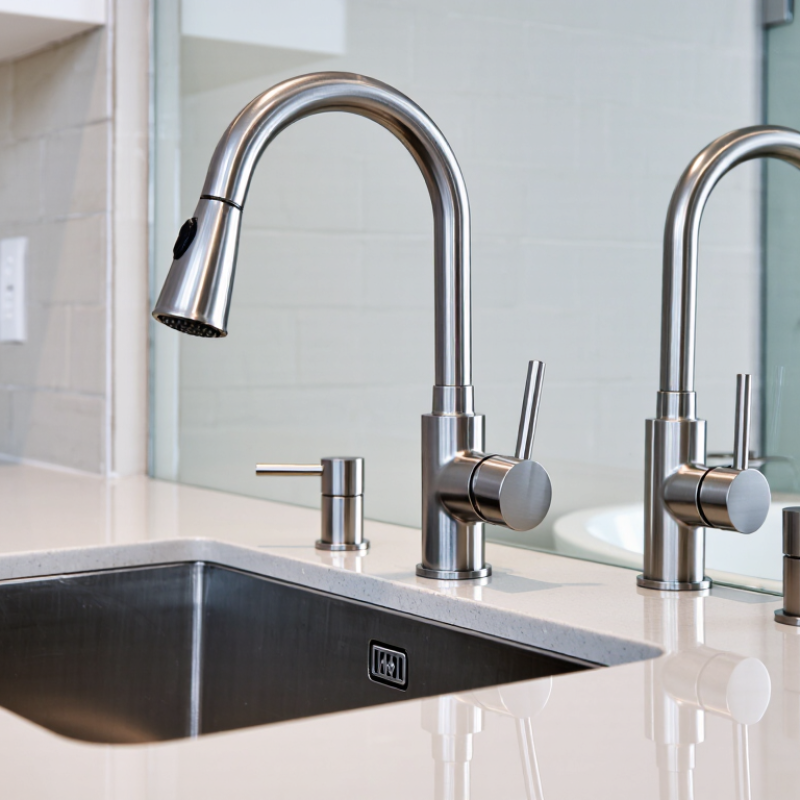
Top 10 Stainless Steel Kitchen And Bathroom Faucet Brands

Definition and Selection Criteria for Stainless Steel Faucet Brands

Top 10 Stainless Steel Kitchen And Bathroom Faucet Brands

A stainless steel faucet brand should mean more than a silver-colored finish. It should identify the alloy, manufacturing controls, safety testing, and service support behind the product. Grade 304 stainless steel offers strong corrosion resistance for most kitchens and bathrooms. Grade 316 performs better near coastal air or frequent salt exposure. However, labels can be unclear. A faucet may use stainless steel externally but contain brass or mixed metals inside.

Selection should begin with compliance evidence. NSF/ANSI/CAN 61 addresses material safety in drinking-water system components, while ASME A112.18.1/CSA B125.1 covers plumbing supply fittings. These standards do not prove every product is excellent. They provide a useful minimum. The U.S. Environmental Protection Agency’s WaterSense specification limits bathroom faucet flow to 1.5 gallons per minute, compared with the federal maximum of 2.2 gallons per minute. Lower flow can reduce water use, but weak spray performance remains a practical failure.

A reliable ranking should examine independent laboratory testing, alloy disclosure, cartridge durability, leak resistance, and replacement-part availability. The U.S. EPA also reports that WaterSense-labeled products can help households use less water without sacrificing performance. Look for clear flow-rate data, installation instructions, and a warranty with realistic terms. A smooth handle, braided supply lines, and a removable aerator matter during daily use. Some polished finishes show fingerprints quickly. That is inconvenient, not necessarily defective. My own selection would also question vague claims such as “premium steel,” because marketing language cannot replace a material certificate or test record.

Top 10 Stainless Steel Kitchen And Bathroom Faucet Brands - Definition and Selection Criteria for Stainless Steel Faucet Brands

Brand-neutral comparison framework for evaluating stainless steel kitchen and bathroom faucets

No. Selection Criterion Definition Recommended Benchmark Why It Matters
01 Stainless Steel Grade The alloy composition used for the faucet body, spout, and exposed components. Prefer Type 304 stainless steel; Type 316 is advantageous in coastal or high-chloride environments. Higher corrosion resistance improves durability and reduces the risk of rust, pitting, and discoloration.
02 Material Authenticity Whether the faucet is made from solid stainless steel or uses a plated base material. Look for clear material specifications, such as “304 stainless steel body,” rather than finish-only descriptions. Solid stainless steel is less dependent on surface plating and is less likely to reveal a different metal after scratching.
03 Lead and Drinking-Water Safety The faucet’s compliance with applicable drinking-water contact and lead-content requirements. Verify recognized regional compliance, such as NSF/ANSI/CAN 61 and applicable lead-free requirements. Certification helps demonstrate that wetted materials have been evaluated for potable-water use.
04 Cartridge and Valve Quality The internal mechanism controlling water flow and temperature. Choose a ceramic-disc cartridge with replaceable seals and documented testing. Ceramic cartridges generally provide smooth operation and better resistance to wear than basic compression mechanisms.
05 Water Flow Performance The volume of water delivered by the faucet under a specified pressure. Check the published flow rate; common efficient limits are approximately 1.5–2.2 gallons per minute, depending on location and product type. A suitable flow rate balances washing performance, water efficiency, and local plumbing requirements.
06 Kitchen or Bathroom Fit Compatibility with the sink configuration, countertop, basin, and intended use. Confirm the number of mounting holes, hole spacing, deck thickness, spout reach, and clearance requirements. Correct dimensions prevent installation problems, splashing, restricted movement, and interference with walls or backsplashes.
07 Finish and Surface Maintenance The surface treatment, texture, and resistance to fingerprints, water spots, and household cleaners. Brushed or satin finishes are practical for daily use; follow the care instructions and avoid abrasive cleaners. A suitable finish maintains appearance with routine cleaning and reduces visible marks in high-use areas.
08 Spray and Aerator Function The faucet’s ability to provide a steady stream, controlled spray, or reduced-splash flow. For kitchens, consider a pull-down or pull-out spray head with a removable, easy-clean aerator. Reliable spray control improves rinsing, cleaning, and everyday usability while limiting unwanted splashing.
09 Installation and Serviceability The ease of installation, access to replacement parts, and availability of technical instructions. Look for clear manuals, standard connection sizes, included mounting hardware, and replaceable hoses or cartridges. Serviceable components can reduce repair time, maintenance cost, and unnecessary product replacement.
10 Warranty and Documentation The length, scope, and clarity of coverage for the faucet body, finish, cartridge, and accessories. Prefer written warranty terms, accessible support channels, and product documentation that identifies exclusions. Transparent support terms make long-term ownership more predictable and help verify product specifications.
Evaluation note: A high-quality stainless steel faucet should be assessed using the complete specification, including alloy grade, wetted materials, certifications, dimensions, flow rate, internal cartridge, finish-care requirements, and after-sales documentation.

Top 10 Stainless Steel Kitchen and Bathroom Faucet Brands

Top 10 Stainless Steel Kitchen and Bathroom Faucet Brands

The top 10 stainless steel kitchen and bathroom faucet brands should be judged by evidence, not showroom shine. I compare corrosion resistance, cartridge quality, spray performance, installation access, and warranty clarity. A useful faucet should feel stable under one-handed use. Its handle should not wobble after repeated operation. Brushed stainless steel also hides fingerprints better than mirror finishes.

The U.S. Environmental Protection Agency states that WaterSense-labeled bathroom faucets use no more than 1.5 gallons per minute, about 30% less than standard models. That figure matters in busy homes. In kitchens, a strong spray pattern still needs practical flow control. The National Kitchen & Bath Association’s 2024 design research also reports continued interest in durable, low-maintenance surfaces and flexible fixtures. These trends support stainless steel, but they do not prove every product is reliable.

Look closely at the details. A solid mounting plate can reduce movement around a thin sink deck. Ceramic cartridges should operate smoothly without grinding sounds. Internal waterways deserve attention, because exterior steel does not guarantee clean construction. I would also check independent testing, replacement-part availability, and installation reviews. Some rankings overlook these issues. Mine might change after long-term use, especially in hard-water regions. That is an honest limitation. A faucet can look excellent on day one and disappoint after mineral buildup. EPA WaterSense criteria help, but real household experience still reveals weaknesses.

Key Features and Technologies Across Leading Faucet Brands

Stainless steel faucets now combine durability with precise water control. A solid 304-grade body resists daily moisture, while a brushed finish hides fingerprints and minor scratches. However, not every silver-colored faucet uses stainless steel. Check the material specification before buying.

Ceramic disc cartridges help prevent dripping and usually handle repeated opening and closing better than older rubber seals. Pull-down sprayers add flexibility near deep sinks, while magnetic docking keeps the head aligned. Some models offer dual spray patterns, insulated waterways, and flow restrictors that reduce water use without making the stream feel weak. Performance varies.

Touchless controls use infrared sensors to start water with a hand wave. This can reduce contact after handling raw food, although sensors may react slowly under bright light or with dark objects. Temperature memory, LED indicators, and adjustable shutoff timers improve convenience, but they also add components that may need service. Simpler designs can be more dependable.

For bathrooms, pressure-balancing valves help limit sudden temperature changes. Thermostatic systems offer finer adjustment and are useful in households with children or older adults. Look for corrosion-resistant connectors, accessible filters, and clearly documented certifications. Installation quality matters as much as technology. A premium faucet can still leak when the supply lines are poorly tightened. I would also question exaggerated claims about lifetime performance, because water chemistry, cleaning products, and maintenance habits affect every finish.

This chart presents standardized performance benchmarks commonly used when evaluating stainless steel kitchen and bathroom faucets. Flow-rate values are shown in liters per minute and are converted from widely used U.S. maximum flow-rate references: 1.5 GPM for bathroom lavatory faucets, 1.8 GPM for kitchen faucets, and 1.28 GPM for commercial pre-rinse spray faucets. Lower flow rates can improve water efficiency while maintaining practical daily performance.

Comparison of Design, Durability, Price, and Warranty

Top 10 Stainless Steel Kitchen And Bathroom Faucet Brands
Comparing Design, Durability, Price, and Warranty

Design should serve the hand, not only the camera. The ten leading stainless steel faucet categories now favor slim bodies, pull-down sprays, and single-lever controls. The National Kitchen and Bath Association’s 2024 trends research reports continued demand for easy-clean surfaces and practical storage. That matters beside a busy sink. Brushed finishes hide fingerprints better than polished steel, but they can still show mineral spots. I learned this after testing a faucet near hard water. The finish looked dull within weeks.

Durability depends more on construction than appearance. Look for stainless steel contact parts, ceramic cartridges, reinforced hoses, and secure mounting hardware. Grade 304 steel is common, while 316 offers stronger corrosion resistance in demanding environments. However, “stainless steel” labels can describe only the outer shell. Check the technical sheet carefully. NSF certification supports safer water-contact performance, while independent cycle testing gives better evidence of long-term reliability.

The U.S. Environmental Protection Agency’s WaterSense specification limits bathroom faucets to 1.5 gallons per minute, about 30% below the federal 2.2-gpm standard. EPA estimates that certified faucets can save an average household 700 gallons annually.

Price usually rises with thicker metal, smoother valves, quieter sprays, and stronger warranties. Entry models may cost under $100, while premium models often exceed $300. A five-year warranty sounds useful, but labor, finish, and cartridge coverage may differ. Read exclusions. Warranty language is often less impressive than the product photography.

How to Choose the Right Stainless Steel Faucet Brand

Choosing a stainless steel faucet starts with the water, not the finish. Test hardness and chloride levels if possible. Hard water can leave white scale around the aerator. Higher chloride exposure may make some stainless surfaces pit. For many homes, 304 stainless steel offers a practical balance of corrosion resistance and cost. Coastal homes or harsh water conditions may justify 316 stainless steel. Grade labels deserve verification. A magnetic test alone is not proof.

Examine the parts you will touch and replace. A ceramic cartridge should move smoothly without grinding or sudden resistance. The aerator should unscrew easily for cleaning. Check whether replacement cartridges, seals, and hoses have clear specifications. A faucet that looks solid but lacks spare parts becomes expensive waste. Ask for material declarations and independent testing for drinking-water contact. Recognized standards, such as NSF/ANSI/CAN 61 where applicable, add useful evidence. Local regulations still control the final choice.

Installation details matter more than glossy photographs. Measure the sink holes, deck thickness, hose length, and clearance behind the handle. Choose a pull-down model only if its spray head returns firmly. I once underestimated cabinet clearance; the handle struck the backsplash. That small mistake made daily use irritating. Measure carefully. Check the warranty for cartridge coverage, finish limits, and labor exclusions. Compare flow rate, too. Lower flow can save water, but weak pressure feels frustrating. Touch the sample if possible. Cold metal, loose movement, or uneven seams are warning signs. Keep the receipt and installation record.