How to Choose Stainless Steel Kitchen and Bathroom Sinks
Choosing Stainless Steel Kitchen And Bathroom Sinks is less about chasing a polished showroom look and more about matching the sink to daily routines. A deep, single-bowl kitchen sink can fit roasting pans and baking sheets, while a divided bowl may help separate food preparation from cleanup. In a bathroom, basin size, faucet reach, and countertop space all affect comfort. Measure the cabinet opening before comparing models. A beautiful sink that does not fit is still the wrong sink.
Sink designer and materials consultant Elena Ward puts it this way: “Choose the bowl for the work you do most, not the task you do once a year.” That is a useful rule, though it cannot settle every choice. Stainless steel varies in thickness, finish, and construction. Thicker steel may feel quieter and more substantial, but installation, mounting style, and sound-dampening pads also matter. Look for clear product specifications, care instructions, and warranty details. A brushed finish can soften the look of everyday marks; it will not make them disappear.
Pay attention to the small details. Check whether a drain opening suits your plumbing, whether a faucet deck leaves enough room, and whether the basin corners are easy to wipe. For kitchens, consider how often you wash large cookware. For bathrooms, think about splash control and the space around the tap. Small choices matter. This guide compares practical features, materials, and layouts so you can choose with confidence. It also leaves room for a less-than-perfect truth: the ideal sink is often a compromise between budget, available space, and personal taste.
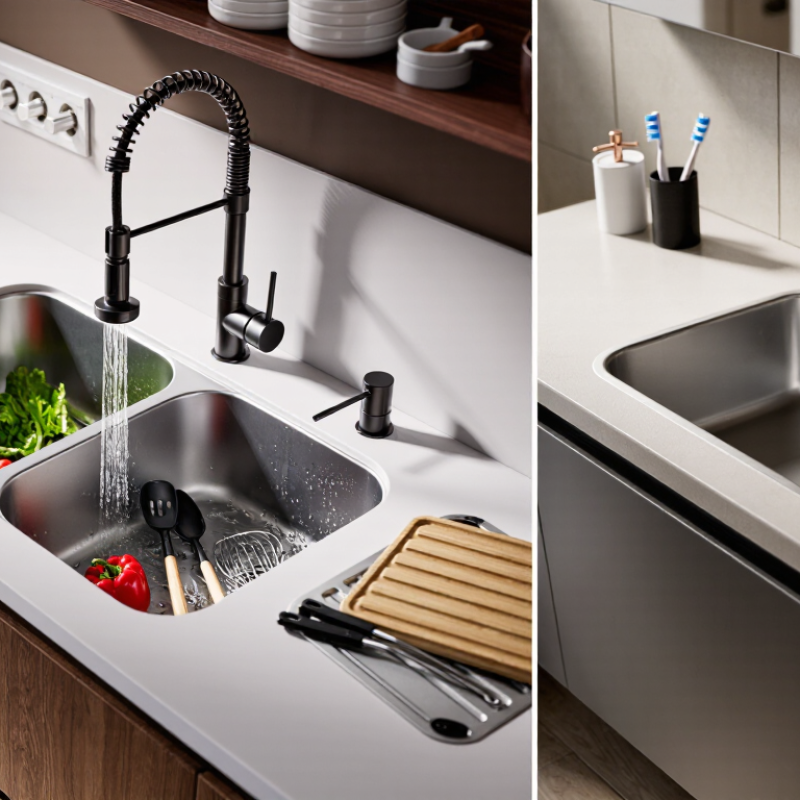
Determine the Sink’s Intended Use and Installation Requirements
Choose the sink around its daily workload. A kitchen basin may need room for stockpots, baking trays, and rinsing produce; a bathroom basin usually needs less depth but better splash control. The Water Research Foundation’s Residential End Uses of Water, Version 2 (2016), found faucets accounted for about 20% of indoor household water use. That figure concerns faucets, not sink basins, but it highlights how often this fixture is used. Measure twice.
Check the cabinet width, countertop material, drain position, and plumbing access before choosing a mounting style. An undermount sink gives a smooth counter edge, but needs a compatible, well-supported countertop and careful sealing. A drop-in rim can suit more surfaces, though crumbs may collect around its edge. Stainless steel thickness matters too: a thicker basin can feel quieter and more solid, but it may cost more. There is no perfect choice for every kitchen.
For bathrooms, check faucet-hole spacing, bowl depth, and clearance from the wall or backsplash. A shallow basin can look neat, yet may splash during ordinary handwashing. Faucet flow is another practical detail: the U.S. EPA WaterSense specification sets a maximum of 1.5 gallons per minute for labeled bathroom sink faucets, compared with the 2.2-gallon federal baseline. Match the faucet and basin before ordering; otherwise, even a quality sink can feel awkward to use.
Compare Stainless Steel Grades and Material Thickness
For a stainless steel kitchen or bathroom sink, compare the grade before judging the finish. Nickel Institute technical guidance lists Type 304 at roughly 18–20% chromium and 8–10.5% nickel. Type 316 contains about 16–18% chromium, 10–14% nickel, and 2–3% molybdenum. That added molybdenum improves resistance to chloride corrosion, but does not make the sink stain-proof. In bathrooms, salty cleaners and standing water can still leave marks.
Thickness affects how the bowl feels when a tap runs or a pan lands inside. As a practical reference, 16-gauge stainless is about 1.6 mm thick; 18-gauge is about 1.3 mm. ASTM A240/A240M provides material specifications for stainless-steel plate, sheet, and strip, but a sink’s formed shape and sound-damping layer also affect rigidity and noise. Gauge labels can mislead. Check the stated thickness in millimeters, and confirm whether it describes the steel itself.
For a busy kitchen, 16- or 18-gauge 304 is a sensible starting point; 316 may suit coastal homes or frequent chloride exposure. For a bathroom with lighter use, 18-gauge may be adequate. I would still compare the bowl’s depth, mounting method, and edge stiffness. A thicker sheet alone does not guarantee a better sink.
How to Choose Stainless Steel Kitchen and Bathroom Sinks - Compare Stainless Steel Grades and Material Thickness
| Material or thickness |
Typical composition or approximate thickness |
Corrosion resistance |
Practical considerations |
Best suited to |
| Type 304 stainless steel |
Typically about 18–20% chromium and 8–10.5% nickel. |
Good resistance to rust and everyday household corrosion. Chlorides and harsh chemicals can still cause staining or pitting. |
A widely used general-purpose stainless grade. Rinse away salt, bleach, and acidic cleaners; dry the surface to reduce water marks. |
Most kitchens and bathrooms, especially where a balance of corrosion resistance and availability is wanted. |
| Type 316 stainless steel |
Typically about 16–18% chromium, 10–14% nickel, and 2–3% molybdenum. |
Generally more resistant than 304 to chloride-related pitting and crevice corrosion; not corrosion-proof. |
Often costs more. Good cleaning and rinsing are still important, particularly around seams and drain fittings. |
Coastal locations or settings with greater exposure to chlorides, when the added corrosion resistance justifies the cost. |
| Type 430 stainless steel |
Typically about 16–18% chromium, with little or no intentional nickel. |
Generally less resistant to corrosion than 304 or 316, particularly in chloride-rich or persistently wet conditions. |
Can be magnetic. Check the stated grade and intended use rather than relying on appearance or a magnet test alone. |
Lower-corrosion-demand uses where the product specification and maintenance requirements are suitable. |
| 16 gauge |
Approximately 1.5 mm (0.060 in). |
Gauge describes thickness, not corrosion resistance; corrosion resistance depends mainly on the alloy and care. |
Thicker sheet may feel more substantial and can reduce vibration, though construction, bowl shape, support, and sound-dampening also matter. |
A useful option when a heavier-feeling sink is a priority. |
| 18 gauge |
Approximately 1.2 mm (0.048 in). |
Gauge describes thickness, not corrosion resistance; compare the steel grade separately. |
A common middle-ground thickness. Overall performance also depends on fabrication, installation, and support. |
Many everyday kitchen and bathroom applications. |
| 20 gauge |
Approximately 0.9 mm (0.036 in). |
Gauge describes thickness, not corrosion resistance; check the alloy specification and finish. |
Thinner sheet may be more prone to flexing or a louder sound if support and sound-dampening are limited. |
Projects where cost and weight are priorities and the sink is adequately supported. |
| 22 gauge |
Approximately 0.75 mm (0.030 in). |
Gauge describes thickness, not corrosion resistance; a thinner sheet is not automatically less corrosion-resistant if the alloy is the same. |
Can feel less rigid and may transmit more noise, depending on sink design and installation. |
Light-duty or budget-oriented applications, after checking the product's construction and support requirements. |
Notes: Gauge-to-thickness figures are approximate US sheet-steel conversions; actual product thickness and measurement conventions can vary. A lower gauge number means thicker sheet. For a fair comparison, verify both the stainless-steel grade and the stated thickness, and consider the sink's construction, finish, installation support, and maintenance.
Choose the Bowl Size, Shape, Configuration, and Finish
Bowl size should match the work you actually do. A 9-inch-deep kitchen sink can hold stockpots, but it may feel tiring if you are short or have limited counter space. Measure the cabinet opening, faucet reach, and plumbing clearance before choosing. Measure twice. For a small bathroom, a compact basin can free counter space, though handwashing may splash more than expected. A wider, shallower bowl often feels easier for daily use.
Shape affects both capacity and cleaning. Straight-sided rectangular bowls make room for baking trays, while rounded corners are easier to wipe clean. Single bowls suit large pans; double bowls let you separate washing and rinsing, but each side may feel cramped. Not always better. In a busy kitchen, compare the usable width of each bowl, not just the overall sink dimensions. For bathrooms, check that the basin leaves comfortable space around the faucet and does not crowd the doorway.
Finish changes the sink’s appearance and upkeep. Brushed stainless steel softens reflections and can make water marks less noticeable, but it will not prevent them. Polished steel looks bright and crisp, yet shows fingerprints more readily. Check a sample under your own lighting if possible; showroom lights can be misleading. A small mismatch is easy to overlook until the sink is installed.
How to Choose Stainless Steel Kitchen and Bathroom Sinks
Typical bowl widths vary by sink type. Use these approximate examples as a starting point, then check your cabinet dimensions and the sink’s product specifications.
Bowl dimensions are not standardized and vary by design. Consider bowl depth, shape, configuration, and finish alongside width when choosing a sink.
Check Faucet, Countertop, Cabinet, and Plumbing Compatibility
A stainless steel sink should fit the way your kitchen or bathroom actually works, not just look good in a showroom. Start with the faucet: count the deck holes and compare their spacing with the faucet’s required layout. Check the countertop thickness and available clearance beneath it, especially for a pull-down faucet with a bulky hose weight. Measure twice. A small mismatch can mean drilling a new hole or changing fixtures.
Next, confirm the sink’s mounting style suits the countertop. An undermount sink needs a compatible, sturdy surface and a clean cutout; a top-mount model needs enough flat counter space around its rim. Check the cabinet’s inside width and depth, not only its outside dimensions. Leave room for clips, rails, and any drawers that might hit the basin. A deep sink may offer useful washing space, but it can also crowd the cabinet below.
Plumbing deserves a close look before you buy. Compare the drain position with the existing trap, supply lines, and disposal, if fitted. A rear-set drain may free up cabinet space, but only if the pipes can reach without awkward bends. Take photos and measurements under the cabinet. Even then, old plumbing can surprise you; I would treat a paper template as a starting point, not a guarantee. A local installer can verify tricky connections before the countertop is cut.
Evaluate Durability, Maintenance Needs, and Cost
When comparing stainless steel sinks, inspect the bowl, corners, and underside—not just the shiny finish. A thicker basin can resist dents and sound less hollow, but gauge numbers alone do not guarantee quality. Check the welds, mounting clips, and finish under bright light. Fine scratches will appear with use. They are normal, though a brushed finish can make them less noticeable.
Maintenance is modest: rinse away salt, acidic food, and cleaning residue, then dry the surface to limit water spots. Avoid steel wool; tiny iron particles can leave rust marks. The International Stainless Steel Forum reports an end-of-life recycling rate of about 85% for stainless steel, a useful durability consideration, not proof that every sink will last equally long. Cost deserves a closer look. The USGS Mineral Commodity Summaries 2024 identifies stainless-steel production as the largest use of primary nickel, at roughly 65% of consumption; nickel-market shifts can affect material prices. Compare installed quotes, including faucet holes, sound pads, and labor. A low price can be tempting. I would still check the underside and warranty terms before deciding.